
Acupuncture and Moxibustion for Breech or Malposition in Late Pregnancy
When your baby is breech or lying sideways in the last trimester, it can feel stressful. Most people want to give their baby the best chance of being head-down for birth. Alongside medical care, some patients ask us about acupuncture and moxibustion.

At The Acupuncture Pregnancy Clinic, we work closely with your medical team to support you safely. Here’s what to know about how treatment works, what research says, and what to expect if you book in.
Why breech position matters
By 34–36 weeks, most babies have turned head-down. If your baby is breech or oblique, your care team may suggest an external cephalic version (ECV) or discuss birth planning options. Acupuncture and moxibustion are not replacements for medical care, but may be used earlier (around 33–36 weeks) to support foetal movement and improve the chance of turning before ECV.
What is moxibustion?
Moxibustion involves warming a specific acupuncture point with a stick of compressed mugwort herb. For breech, the point is BL67 (Zhiyin), located on the outside corner of the little toe. You (or your partner) hold the lit moxa stick near the skin to create a gentle warmth for about 15–20 minutes per side.

Many patients also choose to combine moxa with acupuncture sessions in the clinic. We’ll teach you safe technique and provide clear home instructions.
What the research says
The evidence is not perfect, but several studies and reviews suggest that moxibustion may increase the chance of a baby turning head-down if started before 37 weeks.
- Cochrane Review (Coyle et al., 2023): Moxibustion probably reduces the chance of a baby being breech at birth compared with usual care, though it may not lower caesarean rates. Reported side effects were minor, but safety data are limited.
- JAMA RCT (Cardini & Weixin, 1998): 260 women at 33 weeks used daily moxibustion. More babies turned head-down in the moxa group compared with controls, and foetal movements increased during treatment.
- Spanish Multicentre RCT (Vas et al., 2013): Compared true moxa, sham moxa, and usual care. Results favoured true moxa for version rates.
- Systematic reviews (Yang et al., 2021): Suggest possible benefit but highlight variability across studies and the need for better reporting.
Key point: Moxa may improve the chance of turning, but does not guarantee it. Caesarean rates remain influenced by many factors beyond position.
What to expect if you book in
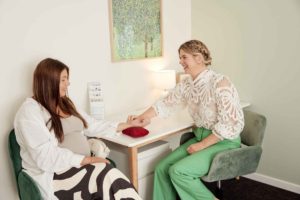
- Initial consult – We confirm your gestation, review safety factors, and discuss research, benefits, and limitations.
- Demonstration – We show you and your support person exactly how to hold and use the moxa safely.
- Home program – Daily moxa at home for 10–14 days, usually starting between 33 and 36 weeks.
- Follow-up – We check progress. If your baby hasn’t turned, we encourage discussion with your midwife or obstetrician about ECV.
- Ongoing support – We continue acupuncture to support comfort, sleep, and preparation for labour.
Safety
Most people tolerate moxibustion well. Minor side effects can include temporary uterine tightenings, nausea, or skin irritation if the stick is held too close. We teach safe distance, duration, and what to do if movements feel reduced (always seek medical care immediately).
FAQs
Does moxa work if I’m already 37+ weeks?
It’s most effective before 37 weeks. After that, there is less space for the baby to turn.
Is it safe for my baby?
Trials report mostly minor, short-lived side effects and more foetal movements. We follow conservative dosing and clear stop rules for safety.
Can this replace an ECV?
No. Moxa is an early option. If your baby stays breech, ECV remains the recommended hospital procedure.
Why BL67?
That’s the point studied in almost all research trials. It’s thought to stimulate foetal movement through neurological and hormonal pathways, though the mechanism isn’t fully understood.
Why choose our clinic?
- We’ve been supporting pregnancy in Sydney, Melbourne, and the Central Coast since 2008.
- Our practitioners have postgraduate training in reproductive health and are mentored in integrative care.
- We provide safe, AHPRA-compliant treatment plans and collaborate with hospitals and midwives.
- Patients value the calm, supportive environment and clear guidance for home practice.

How to book
We offer breech acupuncture and moxibustion support at our Alexandria, Sydney CBD, Westmead, Gosford/Central Coast, East Melbourne, and Mornington clinics.
To book your session, click here or call your nearest clinic. Early booking is best, as timing matters.
References
Cardini, F., & Weixin, H. (1998). Moxibustion for correction of breech presentation: A randomized controlled trial. JAMA, 280(18), 1580–1584. https://doi.org/10.1001/jama.
Coyle, M. E., Smith, C. A., & Peat, B. (2023). Cephalic version by moxibustion for breech presentation. Cochrane Database of Systematic Reviews, 5(CD003928). https://doi.org/10.1002/
Vas, J., Aranda-Regules, J. M., Modesto, M., et al. (2013). Using moxibustion in primary healthcare to correct non-vertex presentation: A multicentre randomized controlled trial. Acupuncture in Medicine, 31(1), 31–38. https://doi.org/10.1136/
Yang, X. Y., et al. (2021). Acupuncture-type interventions for breech presentation: A systematic review and meta-analysis. Complementary Therapies in Medicine, 59, 102709. https://doi.org/10.1016/j.
